
Isotope vs. DNA Analysis for Cotton Origin: Key Differences, Accuracy & Compliance

Isotope testing and DNA tagging answer different questions.
As regulatory scrutiny increases and supply chains face greater pressure to substantiate sourcing claims, brands are turning to a range of tools to strengthen cotton traceability.
Two of the most discussed approaches are stable isotope testing and DNA analysis that comes typically from DNA tagging.
While these methods are often mentioned together, they serve fundamentally different purposes.
Understanding how they differ, and how they can work together, is critical for building a traceability strategy that supports compliance-grade decisions.
Isotope vs DNA Analysis: What’s the Difference
At a high level, isotope and DNA analysis answer different questions:
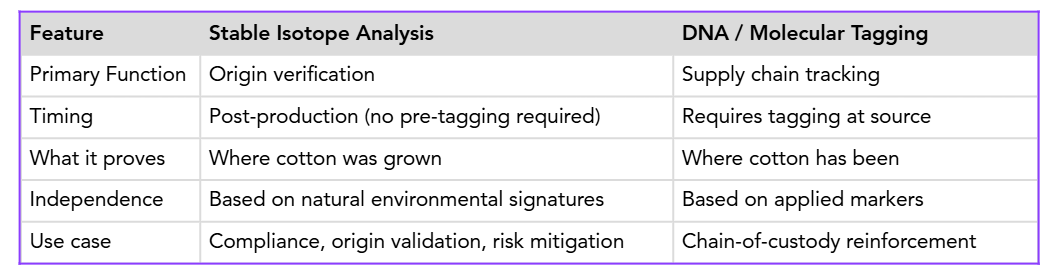
Stable isotope testing: Where was the cotton grown?
DNA analysis (derived from DNA molecular tagging): Where has the cotton moved through the supply chain?
These are complementary, but not interchangeable.

Cotton Isotope Testing can provide independent verification of geographic origin.
How Stable Isotope Testing Verifies Cotton Origin
Stable isotope testing evaluates naturally occurring chemical signatures in cotton fibers. These signatures are influenced by environmental conditions such as climate, rainfall and soil composition.
Key Characteristics of Cotton Isotope Testing:
Does not require pre-tagging or prior intervention
Can conduct testing on fiber, yarn, greige, finished fabric, finished product
Supports verification of origin claims
Used in compliance/due diligence frameworks (including UFLPA, EUDR, CSDDD)

DNA markers can be analyzed later to confirm that the material has passed through specific stages of the supply chain.
How DNA Tagging and Analysis Tracks Cotton Through the Supply Chain
DNA tagging (or other molecular tracer technologies) involves adding a marker to cotton at a known point in the supply chain and enabling authentication from source to finished product.
Key Characteristics of DNA/Molecular Tagging:
Requires tagging at or near the source
Tracks movement through the supply chain
Strengthens chain-of-custody systems
Often integrated with digital traceability platforms
DNA analysis detects the added molecular tag or marker, allowing brands to track material as it moves through the supply chain.
Isotope vs DNA : Key Differences Explained
Can You Use Isotope Testing and DNA Analysis Together?
Rather than competing, these approaches are often most effective when used together.

Cotton isotope testing provides independent verification of geographic origin

DNA tagging and DNA analysis supports traceability through production and processing

Documentation and digital systems record declared transactions
Together, they form a multi-layered evidence framework, where each method contributes a different type of proof.

The standard is shifting from declared traceability to verifiable evidence.
Why This Distinction Matters For Compliance
As regulatory expectations evolve, the standard is shifting from declared traceability to verifiable evidence.
Documentation and digital systems alone may not be sufficient when origin claims are challenged.
In this context: cotton isotope testing provides independent verification of where cotton was grown, complementing digital traceability systems, documentation, and molecular tagging approaches that track and record movement through the supply chain, but do not independently verify origin.
How to Choose the Right Cotton Traceability Method
The appropriate approach depends on your objectives:
If you need to verify origin claims → cotton isotope testing is essential
If you want to track material through your supply chain → cotton tagging and digital systems play a key role
If you need defensible, compliance-grade evidence → a combination of cotton tagging and testing methods is often required
What to Look for in a Cotton Testing and Origin Verification Provider
As organizations evaluate different traceability approaches, selecting the right provider becomes equally important.
Key considerations include:
Independence: Is the provider free from commercial or platform-related conflicts of interest?
Reference data quality: How extensive and well-governed is the underlying database used for origin comparison?
Interpretation and reporting: Are results delivered in a way that supports compliance and sourcing decisions, not just lab outputs?
Scope of capability: Can the provider work across different sample types and integrate with broader traceability systems?

A well-designed cotton traceability strategy often depends not only on the methods used, but on the credibility and structure of the provider delivering them.

GenuTrace for Genuine Traceability
How GenuTrace Supports Cotton Origin Verification and Compliance
GenuTrace provides independent, science-based cotton isotope testing for origin verification, helping brands, retailers, and manufacturers move from declared sourcing to defensible proof.
Our approach is designed to support:
Due diligence and global compliance
Risk-based sourcing decisions
Verification of supplier claims
Integration with broader traceability systems
FAQ: Cotton Isotope Testing for Origin Verification and Compliance
Q. What is the most reliable way to verify cotton origin?
A. Stable cotton isotope testing provides independent verification of where cotton was grown by comparing natural environmental signatures in the fiber.
Q. Is DNA tagging the same as origin verification?
A. No. DNA or molecular tagging tracks cotton through the supply chain, while isotope testing verifies geographic origin.
Q. Can isotope testing support global compliance?
A. Yes. Isotope testing can help support due diligence by providing independent evidence to assess cotton origin claims.
Q. What should companies look for in a cotton origin verification provider?
A. Key considerations include independence, the quality of reference data, the ability to interpret results for compliance decisions, and the provider’s ability to integrate with broader traceability systems.
Visit FAQ on Cotton Isotope Origin Testing for more details
Request a Verification Consultation
To learn how cotton isotope testing for origin verification can support your traceability strategy contact us at sales@genutrace.com
