
What Everyone Needs to Know About Biodegradability Claims
Biodegradability is one of the most widely used, and misunderstood, claims in the textile industry. A material being “biodegradable” does not mean it will safely or effectively break down in real-world conditions. Without proper context, these claims can be misleading and increasingly difficult to defend.
To help cut through the confusion, we spoke with Libby Sommer, an expert in biomimicry, circular design, and material science, about what brands need to understand before making biodegradability claims. This challenge reflects a broader issue across sustainability claims: without clear context, real-world validation, and supporting evidence, even technically accurate statements can create risk. As expectations from regulators, customers, and stakeholders continue to rise, brands are being asked not just to make claims, but to substantiate them.

Libby Sommer
Principal, Libby Sommer LLC | Former Strategic Advisor, Biomimicry Institute
Libby brings over two decades of experience in sustainability, including biomimicry, green chemistry, life cycle assessment, circularity, and human rights.
Website: libbysommer.info
1. From your experience, what is the single biggest misconception brands have about biodegradability claims?
There are many misconceptions around the topic of biodegradability. Perhaps the most important one in my view is that if I make my product “biodegradable”, then it will be harmless regardless of what happens to it.
This belief is understandable and likely reflects what we see in the natural world. But we cannot mimic nature simply by selecting only natural fibers or demonstrating “biodegradability” in a laboratory test.
How do we sure that biodegradable materials do in fact biodegrade?
Think of biodegradation as the outcome of two equally important factors:

The structure, e.g., fiber (and all the chemistry and processing done to that structure) determine whether a textile has the potential to biodegrade, while the environmental conditions control whether in practice biodegradation does occur.
For real-life examples, check out Infosheet #1: Understanding Biodegradation and Textiles, where I explain why onions and strawberries (both biodegradable) don’t break down at the same rate even in the same environmental conditions. As an example of the importance of environmental conditions on real world biodegradation, I compared denim in a compost pile to denim found in a deep sea shipwreck.
Solving the problem of valid biodegradation claims for textiles and consumer goods requires both technical solutions in terms of material and product development, and infrastructure to ensure that biodegradable materials do in fact biodegrade.

How do you prove biodegradability?
2. Why is it so important to clearly state both the timeframe and the environment in which a product biodegrades?
In short, a single laboratory test cannot represent the incredible diversity found in nature.
Some environments (especially those that are warm, wet, and oxygen-rich) provide the most beneficial conditions for biodegradation. But many environments lack the proper conditions to support rapid and complete biodegradation of any material including textiles. Deep oceans have minimal microbial activity due to a lack of critical nutrients among other challenges. Deserts lack moisture that encourages microbial growth, while colder climates suppress microbial activity. Yet, textiles are found in all of these places either as waste or as fiber fragments.
In addition to these practical constraints, many governments require that biodegradability claims be specific about the location and timeframe.
3. Can you share an example where a biodegradability claim was technically “true” but still misleading due to missing context?
In the consumer space, businesses tend to be cautious about making biodegradability claims for good reason. In the B2B space, where claims enforcement is less rigorous, the claims of biodegradability can get pretty wild.
I do recommend keeping a healthy skepticism about lab-supported biodegradation test results, one reason being that labs are not all equally qualified to do these studies. I’ve seen biodegradation test results that to the untrained eye seemed to support biodegradation. But when questioned, that laboratory couldn’t answer basic questions about their study. If it seems too good to be true, it probably is.
Be proactive about the chemistries throughout the textile production process.
Embed circularity principles into the construction of your products.
4. Based on the literature you’ve reviewed, what variables most strongly influence whether a textile biodegrades quickly, slowly, or not at all?
In my first Infosheet, Understanding Biodegradation and Textiles, I created a table to explain this! Well, two tables actually. Recalling that biodegradation is the sum of two critical factors, environmental conditions and the structure of the product or material, I summarized the variables that are known to have a big impact on biodegradation (see Tables 1 and 2 below).
It probably won’t surprise most folks that warmer, wetter environments with lots of oxygen and nutrients are preferential conditions for biodegradation. The impact of the “structure” of a material is perhaps less intuitive. Much of this relates to the molecular structure, although there are macro-level implications like surface area that affect biodegradation rates. To illustrate this latter factor, think of the difference between sawdust and a tree, which are the same molecularly, but sawdust is likely to biodegrade more quickly due to greater surface area available for microbial attack.
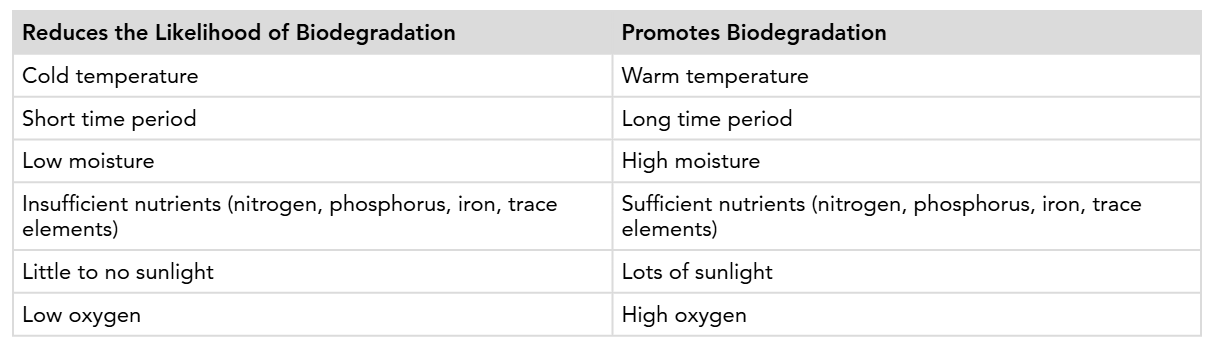
Table 1: Environmental conditions affecting biodegradation
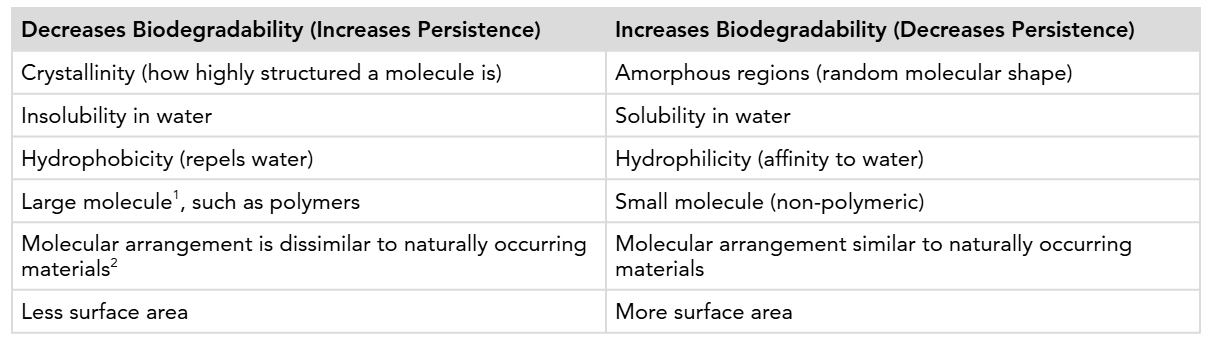
Table 2: Physical and chemical characteristics affecting the potential for biodegradability
5. If you could advise brands on how to make responsible, accurate biodegradability claims, what guidelines would you give them?
The lack of infrastructure at the end-of-life for biodegradable materials makes it difficult to accurately support most biodegradation claims on a consumer product.
However, from the perspective of making materials and products more valuable for reuse and recycling at the end-of-life, I believe manufacturers and brands would be well-served to embed principles of circularity into the construction of their products, AND be proactive about the chemistry that is applied throughout the production process.
In the two decades that I’ve been working in corporate sustainability including green chemistry, life cycle assessment, circularity and human rights, I’ve been delighted about the tools that are now available to help brands do this. For example, Nicole Bassett and her colleagues at Cascade Circular lead expert workshops on product design for circularity. In the area of green chemistry, ChemFORWARD and Enhesa’s SciveraLENS have revolutionized access to information about the impacts of chemicals, enabling the selection of better chemistry during product development.
It’s my desire that we create a future where products and materials can be used again and again before they are broken down into building blocks that can be reused with minimal harm to people and the planet. I encourage everyone, regardless of their role in the industry, to consider how they can be an activator in making our future cleaner, and more circular.
1 The size of a molecule is typically characterized by the molecular weight which is measured in Daltons. A common criterion for large molecules is a molecular weight >500 Daltons.
2 Biodegradation usually begins with the release of enzymes from microorganisms. The process is analogous to a lock and key. Only certain keys will open a given lock. When materials are dissimilar enough from naturally occurring substances, the enzymes are not able to function or “unlock” the biodegradation process.
