
Leading the Dry-Colour Revolution: A Conversation with COLOURizd
By Jennifer Thompson, CEO and Co-founder, COLOURizd
1. What inspired you to create COLOURizd?
Colour has always been central to good design, yet traditional dyeing remains one of the industry’s most resource-intensive and polluting stages. My partners and I wanted to change that. As longtime industry insiders, we had unknowingly contributed to the problem — until we learned enough to know we could do better.
Anthony Lau, Allen Thompson, and I believed there had to be a way to completely rethink how colour is applied. From the beginning, our goal was bold but simple: eliminate water from coloration and achieve zero wastewater discharge. That vision — transforming colour from a pollutant into a pathway for decarbonization — is what sparked COLOURizd.
2. What was the breakthrough that turned this idea into a viable technology?
It was truly a convergence of the right ideas meeting the right moment. Anthony had envisioned this approach years ago, but the chemistry didn’t yet exist. The emergence of nanoparticle pigments changed everything. Suddenly, we could inject pigment and binder directly into the yarn bundle — achieving colour penetration without a dye bath.
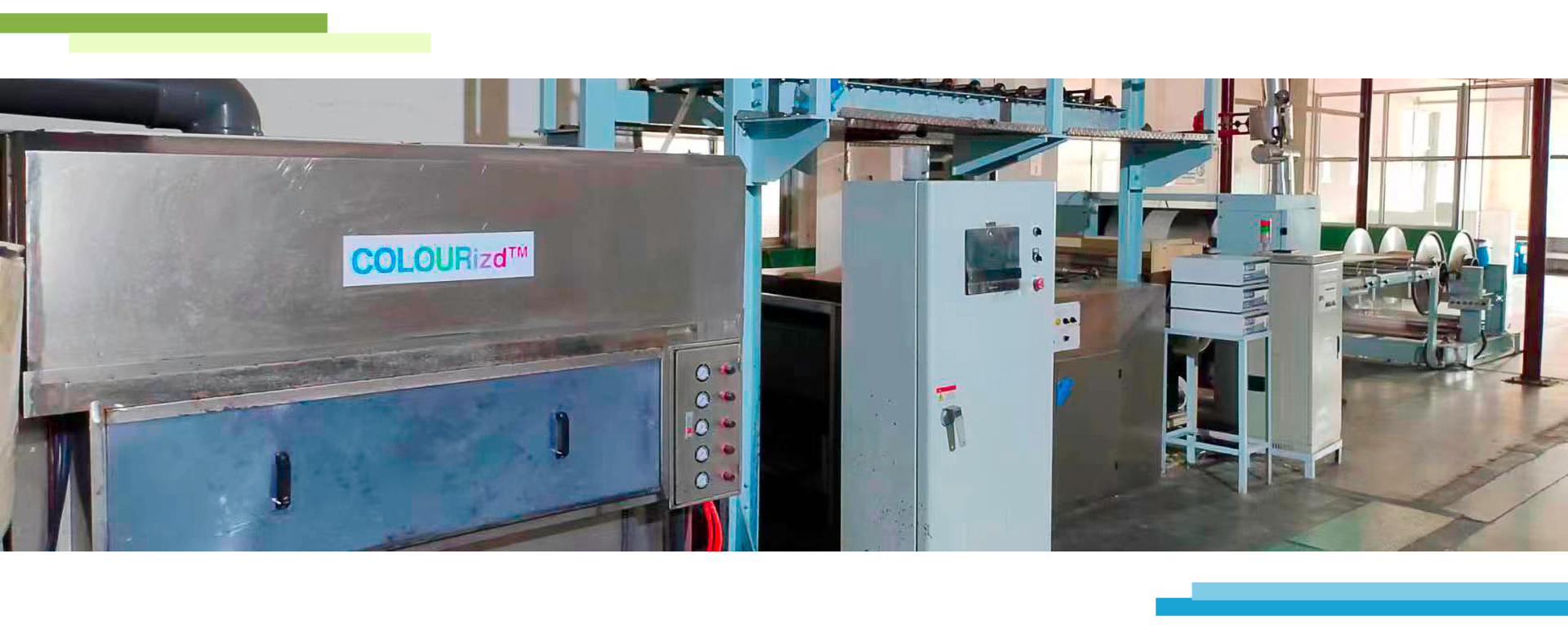
When you pair that chemistry breakthrough with Allen’s deep expertise in capital equipment and my background in product and brand strategy, you get our QuantumCOLOUR technology that is not just novel, but commercially scalable. This is no longer “lab innovation.” It’s an industrial system running real yarns at commercial speed, with no wastewater and dramatically reduced energy consumption.
3. Many say sustainability comes at a cost — but you talk about a “Double Dividend.” What does that mean?
The Double Dividend Protocol, developed by Shivam Gusain, reframes sustainability as an economic opportunity rather than a compromise.
For COLOURizd, the Double Dividend means every kilogram of yarn coloured with our process delivers two forms of return:
Environmental: Meaningful reductions in water, energy, and emissions.
Economic: Lower production costs, faster lead times, and improved yield.
When environmental impact and operational performance align, colour becomes a system of proof — not just expression.
“For something to be truly sustainable, it must reach a point where it costs less. When you use fewer resources and process materials more efficiently, you reduce both waste and cost.” – Jennifer Thompson, CEO COLOURizd
4. COLOURizd promises measurable impact. How are those results verified?
At COLOURizd anchor every claim in data. We measure water, energy, and discharge savings directly at the machine level and validate our results through independent third-party assessments. Multiple LCAs have already been completed on our process, and we’re always happy to share this data with partners.
Traceability with COLOURizd: We also offer a traceability option, allowing brands to authenticate our process all the way to the retail shelf. This moves beyond storytelling — it’s proof, embedded in the product itself.
5. What have been the biggest challenges to adoption?
Changing the dye process is easy compared to changing long-held mindsets. Our industry tends to be cautious, and processes that have been around for decades are often viewed as untouchable. New technology is sometimes met with hesitation.
“To achieve truly radical results, we need radical innovation — and open minds willing to drive those changes across the industry.” – Jennifer Thompson, CEO COLOURizd
6. Many consumers mistrust sustainability claims. How can the industry rebuild credibility?

First, we have to deliver exceptional products. Consumers have been conditioned to believe that sustainability often means compromising on quality, performance, or beauty. That doesn’t need to be the case.
We must use sustainability to enhance products. In our case, the coloration process actually creates stronger, cleaner, less hairy yarns with improved pilling resistance. That directly increases garment longevity — and longevity builds trust.
“We don’t need to market sustainability. Build beautiful product that happens to be sustainable, and it will sell itself.” – Jennifer Thompson, CEO COLOURizd
7. Collaboration seems key to scaling change. What partnerships make the biggest difference?
Every milestone we’ve reached has been rooted in meaningful collaboration. Our work with The Woolmark Company is a strong example — they validated our process on wool and wool blends through development work and independent testing, helping demonstrate technical performance and readiness for wider industry adoption.
Equally important is our collaboration with GenuTrace, which plays a critical role in proving sustainability claims and ensuring verified traceability from raw material to finished product.
GenuTrace’s scientific framework helps establish integrity at the design and development stage — ensuring that innovations like COLOURizd chemistry are not only applied sustainably, but can be measured, monitored, and authenticated throughout production and quality assurance workflows. This strengthens the end-to-end system by linking formulation, provenance, and product performance, creating traceability as a built-in feature rather than a retroactive check.
Across our broader ecosystem — from mills and chemistry collaborators like Archroma to testing labs and manufacturing networks — each relationship contributes the expertise needed to turn innovation into commercial reality.
Behind every breakthrough is a collaboration that aligns purpose with proof. Collaboration isn’t just how the industry scales — it’s how we ensure accountability, protect product integrity, and accelerate transformation from concept to commercialization.
8. Looking ahead, where do you see colour innovation going in the next five years?
Colouration is moving toward a dry factory environment. We no longer have the luxury of relying on the enormous amounts of water and energy required for traditional dyeing and finishing.
Wet processing is the biggest opportunity we have for decarbonization — it represents roughly 36% of a garment’s total environmental impact. That means reducing water and energy use in this stage must become a primary focus for brands and retailers. Even when brands choose the “most sustainable” fibers, if those fibers go through conventional wet processing, they miss the majority of their impact-reduction potential.
The next five years will be defined by technologies — like COLOURizd — that radically reduce or eliminate water and energy use. That’s where the future of colour is headed.

As CEO and Co-Founder of COLOURizd, Jennifer is leading a new era in textile coloration—one grounded in scientific validation, resource efficiency, and proof-based transparency.
About Jennifer Thompson
Jennifer Thompson is a respected textile industry authority, seasoned entrepreneur, and champion for sustainable innovation with traceability at its core. With more than two decades of leadership across product development, manufacturing, and commercialization, she has shaped how brands and suppliers think about color, chemistry, and environmental performance in modern supply chains. Her work is accelerating the industry’s transition away from legacy dyeing processes toward solutions that dramatically reduce water, energy, and chemical impact while enabling measurable accountability and trust.
Contact:
COLOURizd
Telephone: +1-704 650 6715
E-mail: info@colourizd.com
