
Digital Twins Are Powerful: But Trust Still Depends on the Physical World
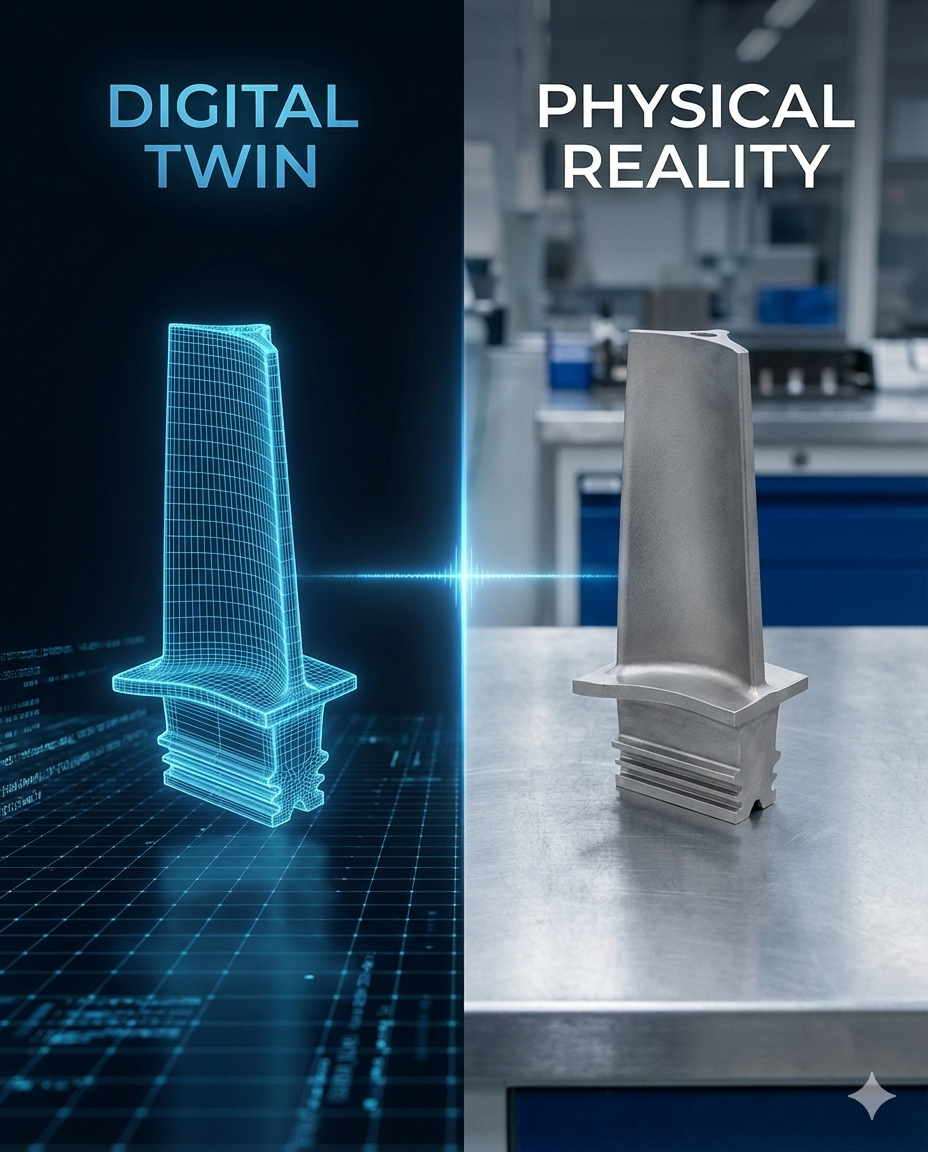
Digital Twin is the digital identity of a physical item.
By Tobias Herzog and MeiLin Wan
The rise of the digital twin is transforming how companies manage products and materials across global supply chains.
A digital twin acts as the digital identity of a physical item, capturing specifications, origin data, sustainability attributes, compliance records, and lifecycle information.
In theory, the digital twin should eliminate uncertainty. In practice, the physical world introduces complexity that digital systems alone cannot control. Labels are removed. Materials are blended. Components are substituted. Documentation becomes separated from products.
Over time, the connection between what is recorded and what physically exists can begin to drift.
A digital twin may describe a product perfectly. But description is not proof.
Why Traceability Claims Are Increasingly Questioned
Across global supply chains, organizations increasingly make claims about materials and products:
This is authentic
This is compliant
This is recycled
This is responsibly sourced
This is of declared origin
Yet every claim now faces a defining challenge: If you claim it — can you prove it?®
Markets, regulators, and customers are steadily shifting toward the same expectation: Assertions must be supported by verifiable evidence.
Not simply documented. Not merely declared. But demonstrably true.
Digital infrastructures are extraordinarily effective at storing, organizing, and transmitting information. They are essential for traceability frameworks such as Digital Product Passports and compliance systems.
However, digital records rely on a fragile assumption: That the physical object continues to match its digital representation.
Once materials move through complex production and sourcing networks, this assumption becomes increasingly difficult to defend without direct interaction with the material itself.
Data can persist indefinitely. Physical integrity cannot be assumed indefinitely. This is the structural gap that many industries are now confronting.
From Digital Twins to Verifiable Twins
When physical detection systems integrate with digital infrastructures, the role of the digital twin evolves.
It becomes more than a passive container of information. It becomes a verifiable twin; continuously reconcilable with the physical world.
This dramatically improves confidence in areas such as:
Material identity
Product authenticity
Composition consistency
Process verification
Compliance validation
Critically, verification no longer depends on the survival of labels, tags, or paperwork. The material itself becomes part of the trust architecture.

Verifiable twin.
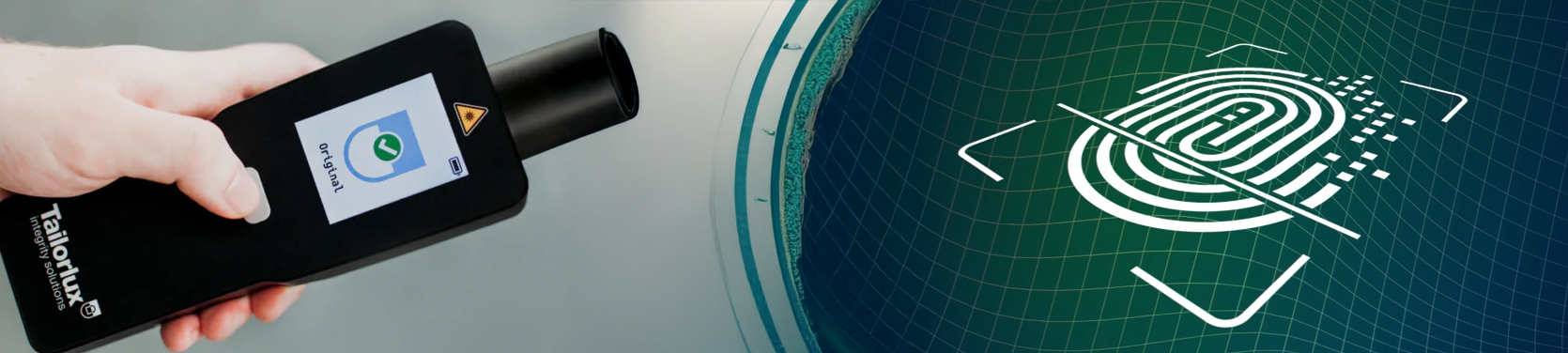
Tailorlux’s handheld scanner helps to verify physical materials using a digital verification system.
Tailorlux’s system is designed specifically to address this gap by allowing physical materials to participate directly in digital verification systems.
Rather than relying solely on external identifiers or documentation, Tailorlux uses advanced optical sensing technologies capable of detecting material characteristics quickly and non-destructively.
This enables a powerful shift: Instead of asking whether records say something is correct, organizations can evaluate whether the material itself confirms it.
Tailorlux’s approach effectively links:
Physical material properties

Instant optical detection
Digital data environments
In doing so, the digital twin is no longer just a stored description, it becomes anchored to measurable physical reality.
Proof Is Strongest When Technologies Work Together
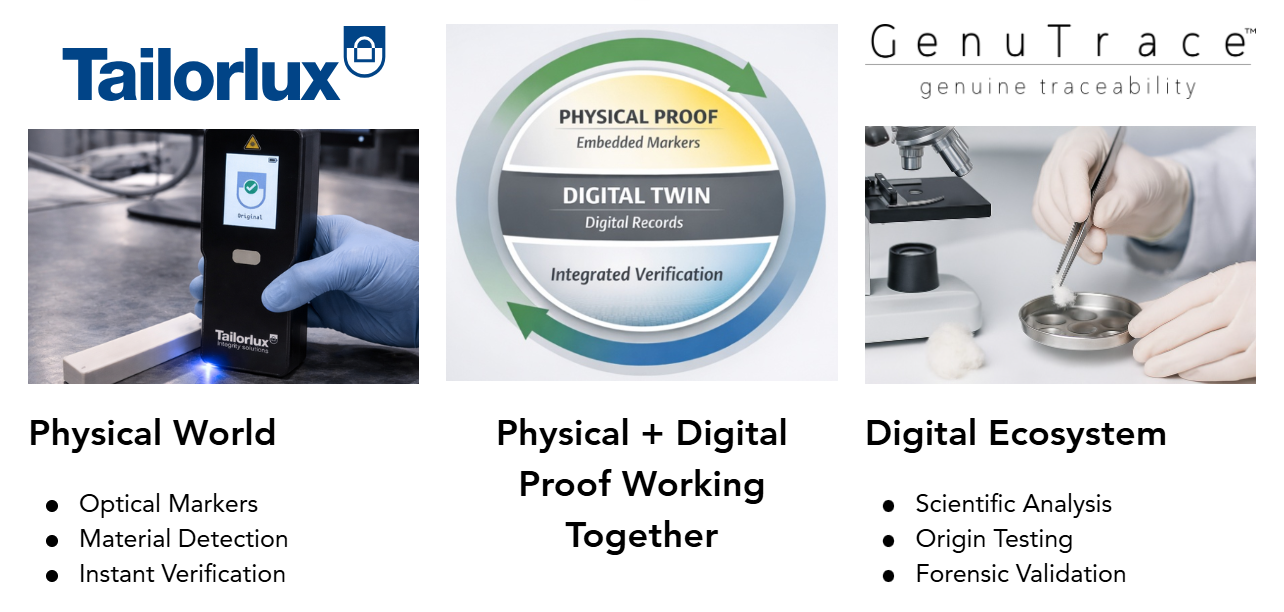
A Digital Twin enables Physical and Digital Proof to Work Together
Material trust is rarely secured by a single mechanism. Resilient systems emerge when multiple verification layers interact:
Digital twins & data systems
Physical sensing & detection technologies
Scientific analytical verification
Chain-of-custody controls
Tailorlux’s ability to directly integrate physical detection with digital systems addresses one of the most persistent weaknesses in traceability models: the loss of reliable connection between records and reality.
Scientific verification frameworks such as isotope testing provided by GenuTrace extend this model by enabling defensible evaluation of complex claims.
Where Scientific Verification Adds Depth
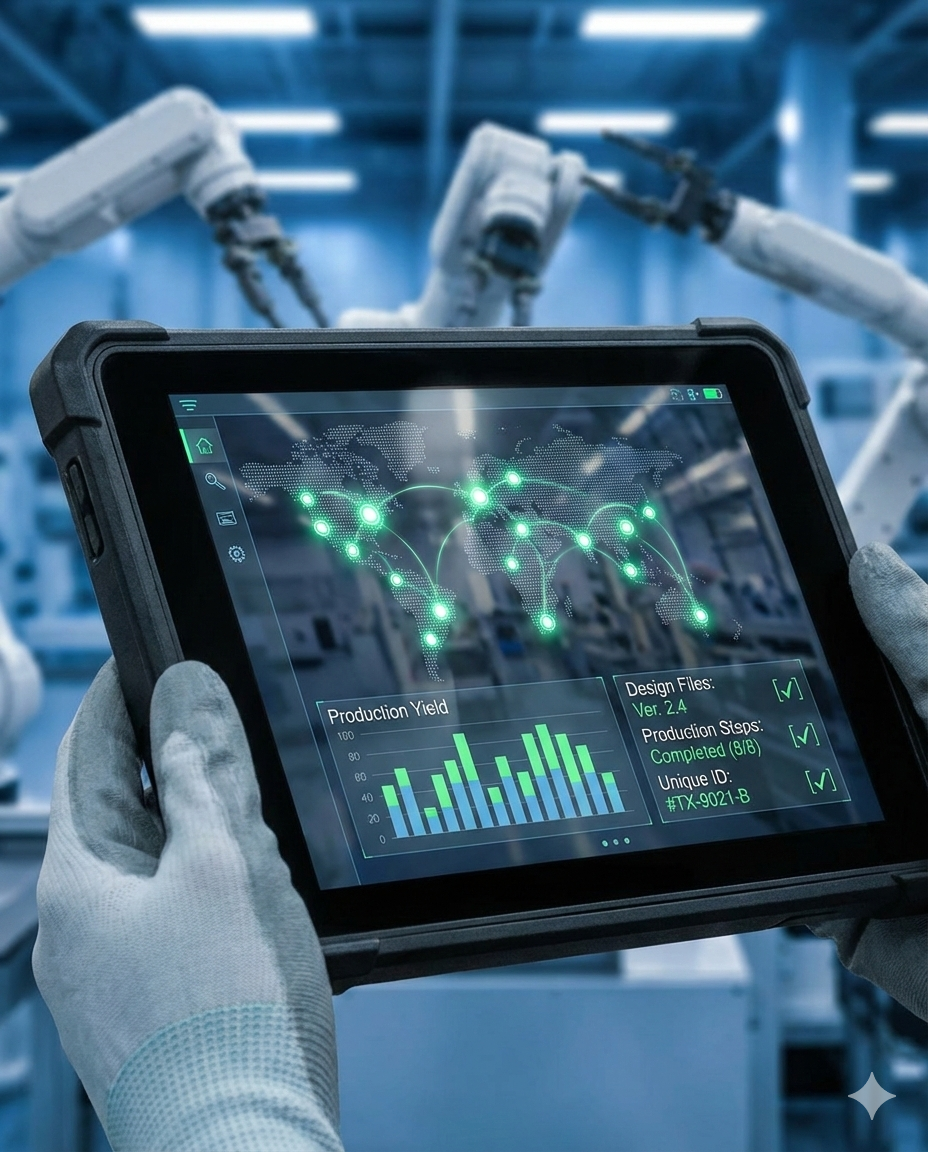
GenuTrace helps provide scientific verification.
While optical sensing technologies provide rapid, scalable physical linkage, scientific analytical methods play a complementary role in validating deeper material attributes.
This is where organizations such as GenuTrace operate.
GenuTrace focuses on scientific verification of material claims that require laboratory-based analytical rigor including:
Origin verification using stable isotope testing and/or trace element analysis
Fiber and material profiling
Consistency with declared sources
Independent forensic validation
These methods do not compete with sensing technologies, they reinforce them. Together, they form layered evidence models.
Beyond Identification: Why Quantification Matters
Modern verification systems are increasingly expected to do more than identify. They must quantify.
Organizations must assess:
Whether composition matches specifications
Whether materials align with origin claims
Whether blends are consistent with declarations
Whether physical objects truly match digital twins
Quantification transforms trust from a matter of belief into a matter of measurement. This shift is central to emerging regulatory and commercial expectations.
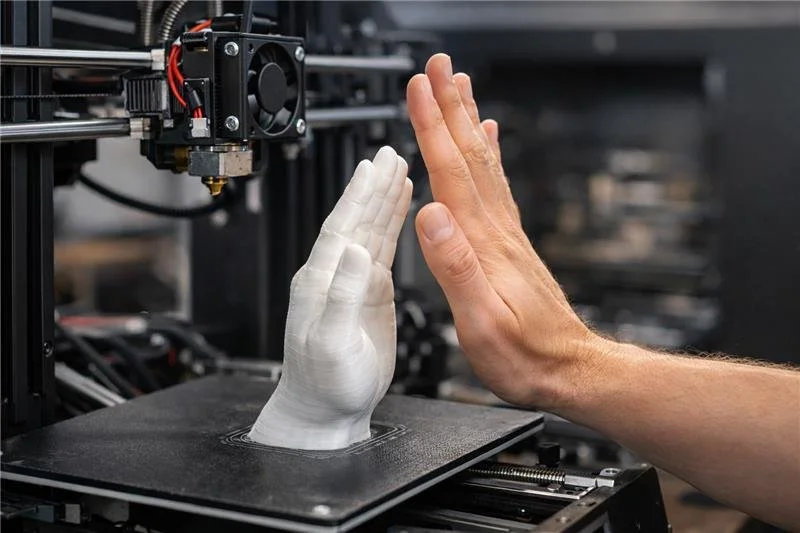
Quantification transforms trust from a matter of belief into a matter of measurement.
Claims Must Withstand Scrutiny

If you claim it — can you prove it?
Across industries, expectations are hardening:
Transparency is not enough.
Documentation is not enough.
Assertions are not enough.
If you claim it — can you prove it?®
Digital twins remain essential. But their credibility increasingly depends on technologies that connect digital records to physical reality.
Tailorlux’s system represents a critical advancement in this evolution by enabling materials themselves to become verifiable participants in digital ecosystems.
Because ultimately: Digital systems describe. Physical systems detect. Science verifies. And together they create trust.
GenuTrace Traceability | Origin Verification | Scientific Evidence
About GenuTrace
GenuTrace specializes in science-based supply chain traceability and origin verification. The company focuses on helping brands, manufacturers and retailers move from declared transparency to verifiable, defensible proof of material claims. Through forensic fiber analysis, stable isotope testing, and multi-layer verification frameworks, she helps organizations strengthen trust in sourcing, sustainability claims and regulatory compliance across global supply chains.
About Tailorlux Integrity Solutions
Tailorlux specializes in optical marker technologies that connect physical materials with digital traceability systems. Tailorlux’s innovations enable rapid, non- destructive verification of embedded markers across global supply chains. Tobias has worked extensively with brands and manufacturers to deploy physical authentication technologies that strengthen traceability, product integrity and digital product passport frameworks.
